
Mainhattan Meets Manhattan
We compare Frankfurt neighborhoods with their NYC counterparts.
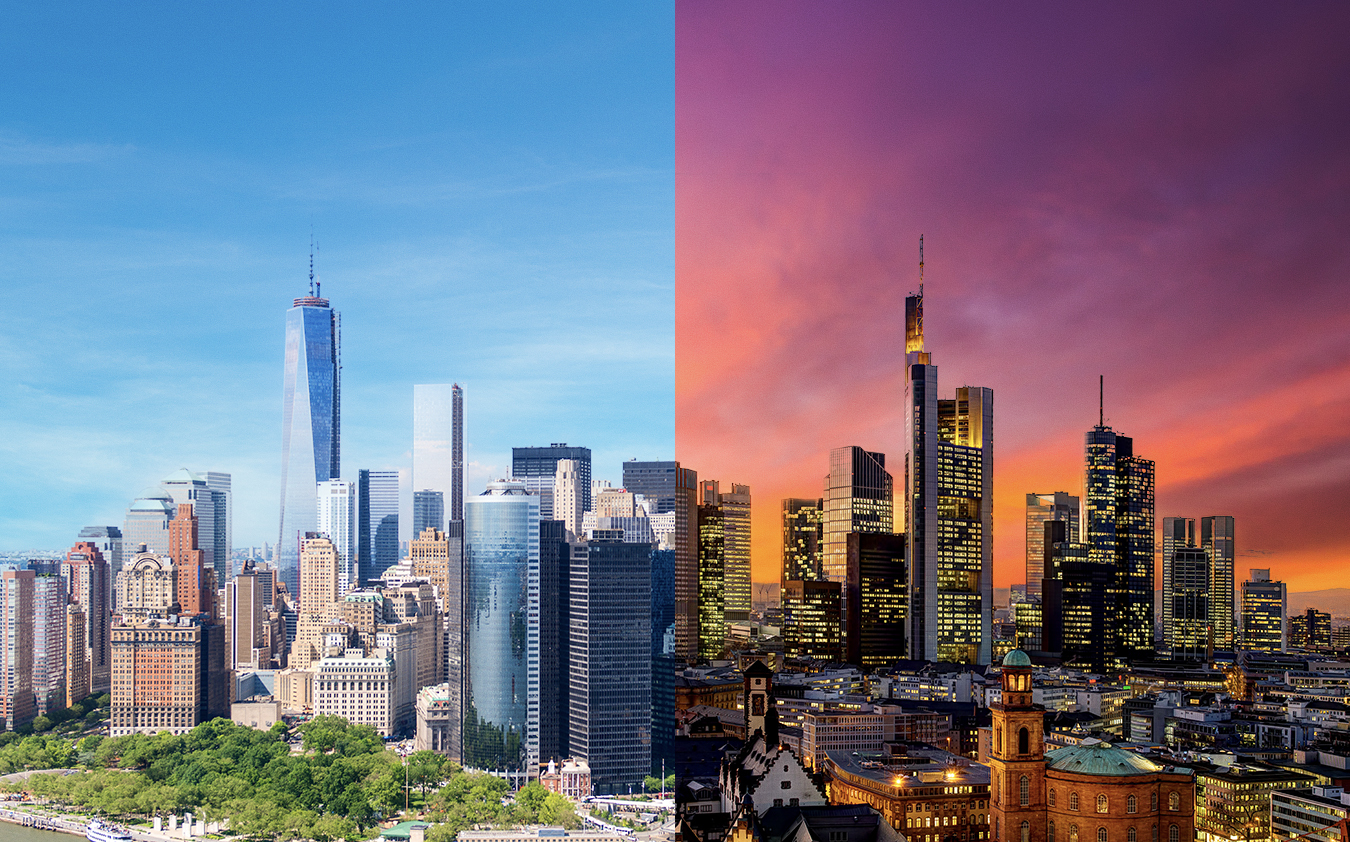
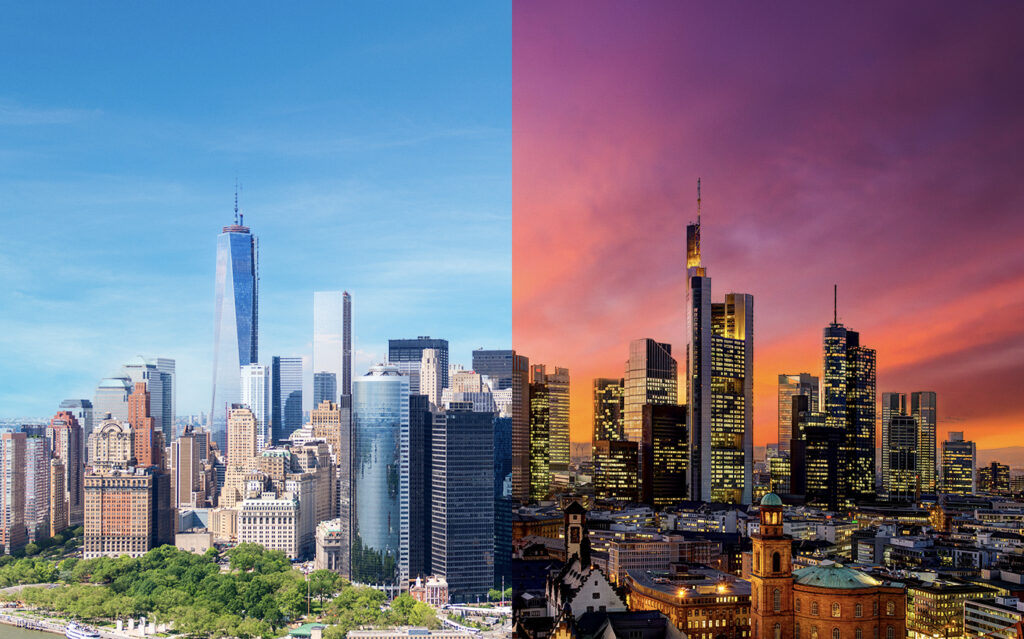
A top real estate brand isn’t the only thing Manhattan and Frankfurt am Main share — Mainhattan, Frankfurt’s lighthearted nickname, acknowledges both the city’s location on the River Main and its similarities with New York City. These two global financial capitals have more in common than meets the eye, and even more that does. Here are six uncanny neighborhood pairings between them.
—
Westend – Upper East Side
Financial markets may be unpredictable, but the industry’s hubs are buzzing constants. Frankfurt’s Westend sits close by the Frankfurt Stock Exchange and the Bankenviertel, making it an ideal location for bankers working in a business where face time with colleagues is non-negotiable and a short commute is paramount. That coveted convenience, coupled with classic architecture, makes for a lifestyle akin to living on Manhattan’s Upper East Side while working in Midtown. Even the real estate feels similar: Westend offers Wilhelminian Altbau — apartments built in the late 19th- and early 20th-century with charmingly high ceilings, tall windows, and hardwood floors — in converted turn-of-the-century townhouses, Frankfurt’s answer to New York’s prized prewar apartments, which similarly showcase high ceilings, hardwood floors, and decorative flourishes. For Neubau, or postwar apartments, options range from buildings built in the 1950s to new developments at the cutting edge. Both neighborhoods also cherish their green spaces: In New York, Central Park is the place to be, while Frankfurt residents love to wander through the Frankfurt Botanical Garden.
Nordend – West Village
What visitor strolling through Nordend or the West Village hasn’t been struck by a deep pang of desire, fervently wishing for a home in one of these lovely enclaves? Nordend and the West Village feel like small towns in bustling metropolises, each neighborhood beloved for its gorgeous historic buildings and quaint streets lined with adorable boutiques and eateries.
In the 1960s and 70s, Nordend was Frankfurt’s epicenter of the West German student movement, not unlike how the Village became central to American counterculture. And as the Village is home to NYU, Nordend has Goethe University, partially located in nearby Bockenheim. Free spirits still linger in both neighborhoods, with café culture still very much alive and well. In Nordend, Friedberger Markt is the summer hangout of choice, with all of Frankfurt coming for drinks and snacks — just as everyone gathers around NYC’s Washington Square Park fountain to cool down the minute the weather warms up.
Europaviertel – ️ Hudson Yards
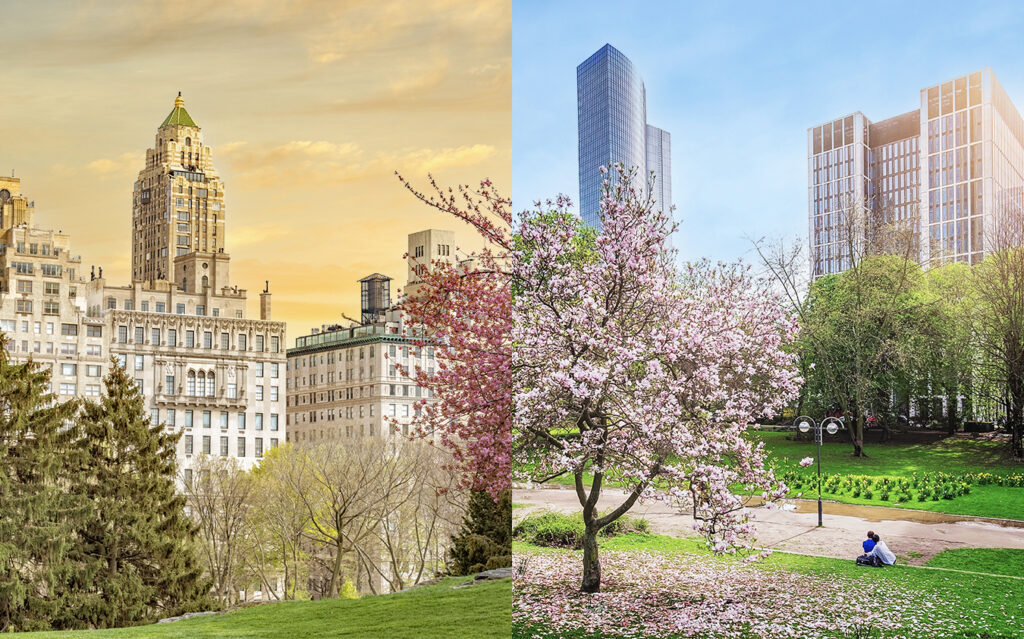
Europaviertel and Hudson Yards feel like long-lost twins. Both are modern developments built atop old rail yards, creating two entirely new residential neighborhoods in two equally historic cities. These are the neighborhoods for those looking for recent buildings — even brand-new ones. You won’t find any old-fashioned apartments here, but rather modern units with floor plans and amenities geared toward contemporary tastes, with super-speedy elevators, soundproof walls, and hidden courtyard gardens, designed for residents’ eyes only. Both have a shopping complex: The Shops & Restaurants at Hudson Yards and Skyline Plaza in Europaviertel (each boasting an H&M store, proving that no one can resist Swedish fast fashion) both offer convenient shopping and dining options for these neighborhoods. Europaviertel and Hudson Yards are both engineering feats of wonder, seemingly rising out of thin air, though due to their industrial pasts are situated farther from the city centers than more established neighborhoods.
Bockenheim – ️ Morningside Heights
Frankfurt and New York City may both be international financial capitals, but they’re also college towns, each home to major powerhouse universities. It’s fitting that Bockenheim, Frankfurt’s primary student district and home for many years to the main campus of Goethe University, finds its match in Morningside Heights, a neighborhood dominated by Columbia University, particularly as the two universities have direct, longstanding ties. Goethe University is home to the Institute for Social Research, the institutional home for the Frankfurt School, a school of thought associated with major philosophers like Max Horkheimer, Theodor Adorno, and Walter Benjamin. The Institute has also long been affiliated with Columbia, taking up residence in New York City between 1934 and 1951. From 2001 to 2017, it was under the leadership of Axel Honneth, a professor at both schools. Cafés, casual bars and pubs, as well as long conversations discussing everything and anything thrive in these scholastic enclaves, with both neighborhoods being known for their wide selection of international eateries alongside student hangouts like the Hungarian Pastry Shop (Morningside Heights) and Strattcafé (Bockenheim). You’ll find students and professors debating philosophy, as well as equally weighty matters of the heart, at local hangouts. Print media flourishes in both Bockenheim and Morningside Heights, where independent bookstores are essential businesses and where you’re more likely to see someone reading a novel over a slice of torte than scrolling on a phone.

️Sachsenhausen – Upper West Side
Sachsenhausen and the Upper West Side both are home to historic districts that could pass as unchanged, sepia-toned versions of their current selves. Sachsenhausen boasts traditional half-timbered houses with steeply pitched roofs, window boxes bursting with geraniums, gas lamps that hiss when you lean in close, and cobblestone streets embedded with brass apples plaques, while the Upper West Side’s iconic buildings include The Dakota, a German Renaissance-style co-op, built in the 1880s, and The San Remo and The El Dorado, built in the early 1900s by Emery Roth, who shaped the look of much of Manhattan. Less well-known than those majestic apartment buildings, but truly looking like a page out of a storybook is the Upper West Side’s Pomander Walk, a block of 27 buildings of theatrically Tudor houses that would fit right into Sachsenhausen without changing a brick. The waterfront is an integral part of both as well, with the River Main bordering Sachsenhausen, and Riverside Park running alongside the Hudson River.
There is plenty of culture to be found on both sides of the Atlantic: Sachsenhausen’s embankment is home to Frankfurt’s museum district, Museumsufer, with multiple cultural institutions lined along the waterfront. Highlights include the Städel, with 700 years’ worth of art, and the German Film Institute and Film Museum, which shows cinema from all around the world. Meanwhile, the Upper West Side has the American Museum of Natural History, The New York Historical, and of course, Lincoln Center, home to the Metropolitan Opera, the New York Philharmonic, the New York City Ballet, and Film at Lincoln Center.
Bornheim – East Village
With Bornheim’s nickname being Das lustige Dorf, or “the merry village,” it’s fitting that the East Village, its New York counterpart, also sports the designation of “village” in its name. Both are lively districts, once known for their licentious past and now mostly all spiffed-up, but every now and then, a whiff of their earlier — and wilder — incarnations drifts across the cool restaurants, stylish bars, and indie boutiques, a reminder that the past always informs the present. Long-time New Yorkers may shake their head that CBGB became a John Varvatos store, but plenty of louche drinking establishments still exist, from the underground sake bar Decibel, opened in 1993; PDT, a speakeasy-style bar entered through a phone booth in a hot dog store; and Holiday Cocktail Lounge, opened in 1950 in an 1835 building, and which has served everyone from Leon Trotsky to Iggy Pop. Bornheim has all the craft cocktails you could want, including the many options on the famous Berger Straße, and it also is home to some of the city’s oldest apple wine taverns: Apfelwein Solzer, founded in 1893, continues to serve delicious cider and traditional German cuisine.