
Appreciating NYC’s Everyday Landmarks
Clocks. Fences. Trees. In New York City, even the seemingly ordinary things can hold significance.
The Empire State Building. MoMA. Mr. Met. Icons all, each unquestionably so. However, there are plenty of such structures, institutions, and anthropomorphized baseballs across the five boroughs, things we universally agree make New York City what it is. If this story began “The Brooklyn Bridge. Radio City. Mrs. Met.” not a single eyelash would have been batted.
Yet, NYC’s overwhelming status as an epicenter of history and culture means that the general public often doesn’t recognize some of its genuine landmarks as being so — whether it’s because they hide in plain sight, are taken for granted as fun neighborhood quirks, or are subject to blissful, no-malice-attached ignorance.
Consider this then an opportunity to get excited about and give flowers to seemingly mundane things with surprisingly substantial resumes, all designated as New York City Landmarks (NYCL), listed on the National Register of Historic Places (NRHP), or both.
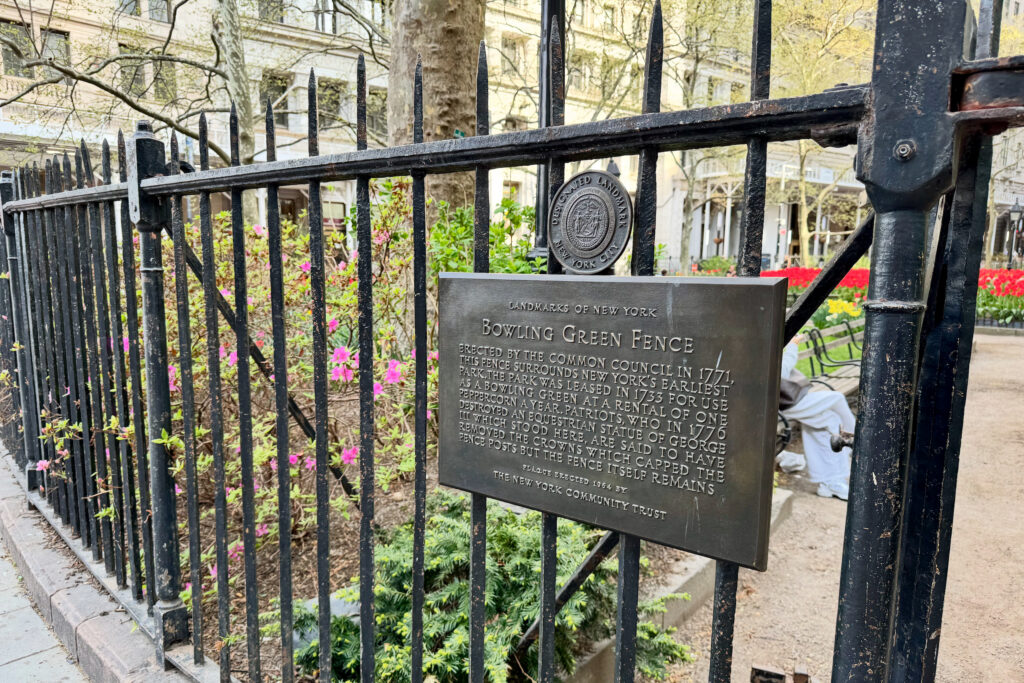
Bowling Green Fence
Typically, fences have defined roles and stick to those roles the only way fences can: by standing unremarkably still. At Lower Manhattan’s Bowling Green, considered one of the city’s first parks and previously a literal green for the bocce-like game of bowls, there is a fence that has largely remained in place since before the United States was officially born. When it comes to surprisingly important things in NYC that would otherwise seem old and boring, the Bowling Green fence is the oldest and most boring (and we hope it takes that as a compliment).
The wrought iron structure was erected in 1771 with the express purpose of protecting an equestrian statue of King George III modeled after a Roman emperor, an easy target for protest amid boiling anti-Crown sentiment. On July 9, 1776, the fence failed at its one job when soldiers and folks, freshly revved up upon hearing the Declaration of Independence read aloud for the first time in New York, took a symbolic stance and literally toppled the gilded lead statue, summarily hacking it to pieces. Amid the fracas, ornamental crowns topping each fence post got sawn off and remain missing today, melted long ago alongside the King George statue into musket ball ammunition for the Continental Army (or so the story goes). You can’t unring a bell, and you certainly can’t unmelt a musket ball.
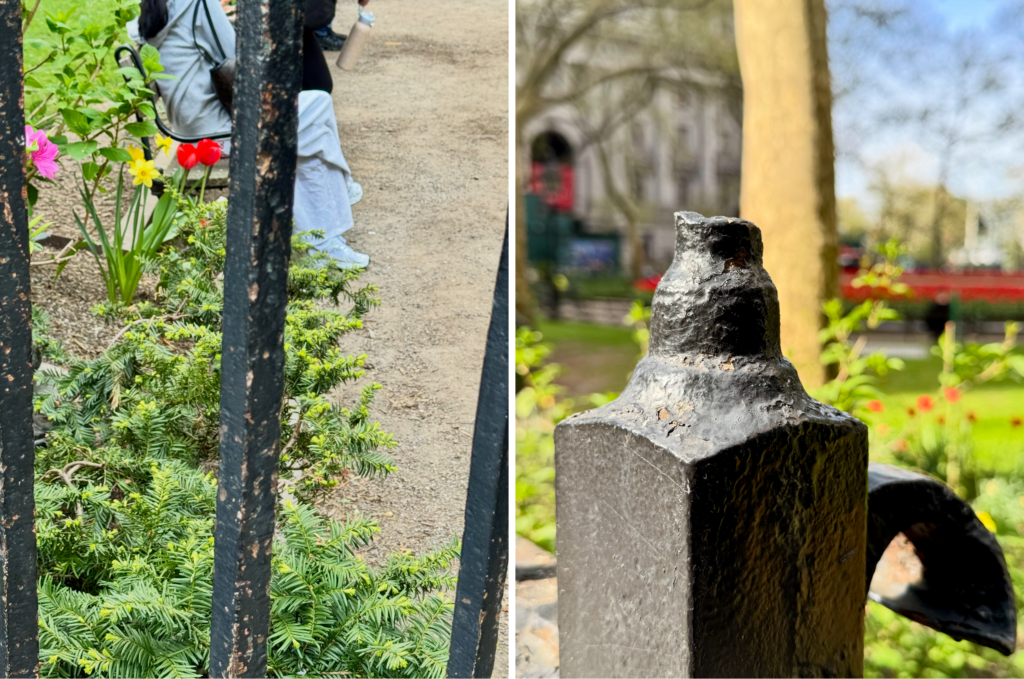
When the final British ship sailed out of New York in 1783, and soldiers raised the American flag in Bowling Green (heroically climbing a greased-up pole to do so), the fence was still there. Save for a five-year absence to accommodate subway construction, it has remained, doing what a fence does best. Today, it rings around a concrete fountain, a centerpiece far more palatable to all. Where it once created a boundary, the Bowling Green fence now serves as a physical marker of the revolutionary verve that spurred this country to independence. Plus, because it thankfully would be demented to build a fence around a fence, it’s pretty cool that you can stroll up to and easily touch one of the oldest handmade objects in the city.
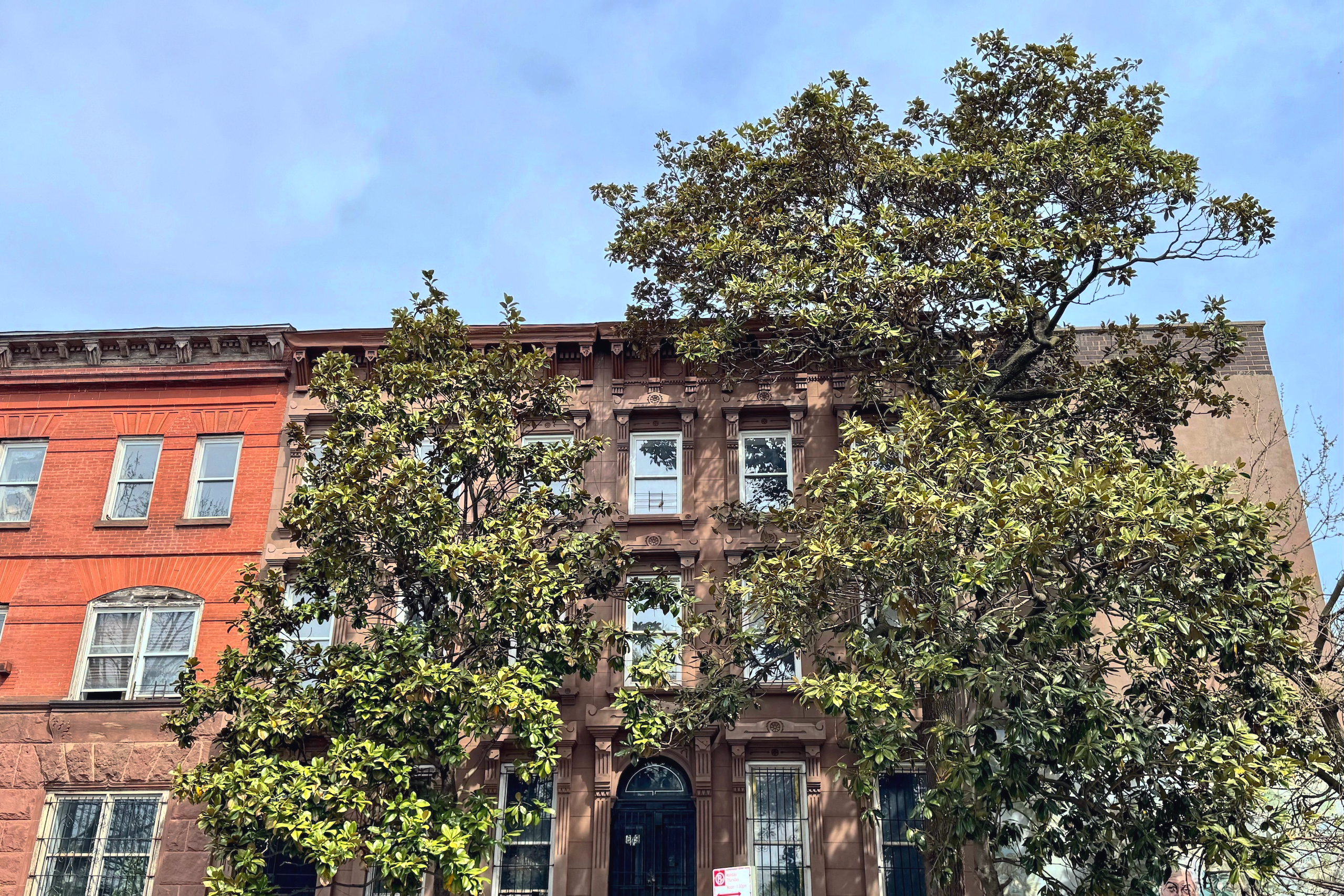
Magnolia grandiflora
It’s a landmark, and it’s alive. The southern magnolia tree at 679 Lafayette Avenue in Bedford-Stuyvesant is a triple threat of extraordinary endurance, historic value, and aesthetic beauty. As the name implies, the southern magnolia (magnolia grandiflora if you’re feeling scientific) tends to be more of a southern U.S. thing. One flourishing at this latitude outside of botanical garden conditions is quite uncommon. Arriving as a seedling from North Carolina and planted around 1885, this tree is significantly older than the average living New Yorker, having outstayed many other transplants along the way. And yet, in spite of it all, she doesn’t look a day over 140.
Perhaps the only other living thing in Brooklyn history as persistent as the southern magnolia was Hattie Carthan, adoringly known as “the tree lady,” who essentially single-handedly reversed the decline of Bed-Stuy’s tree population starting from the mid-1960s until her passing in 1984. Carthan rallied support from neighbors, the Parks Department, and Mayor John Lindsay to plant and preserve a new lineage of urban greenery. Her efforts included advocating for the southern magnolia’s landmark status and purchasing the surrounding three buildings to establish the Magnolia Tree Earth Center, which continues the spirit of Carthan’s mission today.
Of course, there are hyper-specific hazards that come with being a living landmark — like death. Flushing’s Weeping Beech (designated an NYCL in 1966 and added to the NRHP in 1972) predated Bed-Stuy’s magnolia by nearly 40 years, stood alongside Queens’ second-oldest house, the Kingsland Homestead, and purportedly propagated America’s entire weeping beech population, before declining health forced the city to remove it in 1998 (though a new beech, derived from the original, was replanted in its place in 2022). Living landmarks won’t last forever, making Bed-Stuy’s magnolia grandiflora all the more worth protecting and admiring while possible.
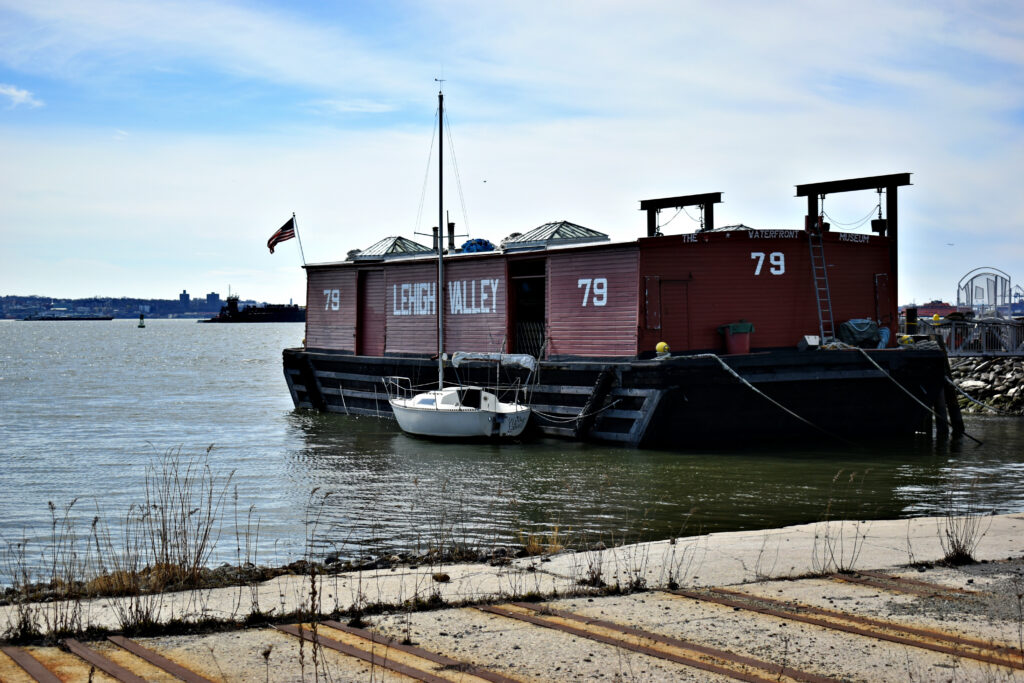
Mary A. Whalen and Lehigh Valley Railroad Barge No. 79
Boats and Red Hook are tied together like, well, boats to a Red Hook pier. Watercraft are an inextricable part of the Red Hook story. It’s all too appropriate that the only two entries on the NRHP attributable to the neighborhood are boats.
The Mary A. Whalen is a “bell boat” oil tanker from the late 1930s that once delivered petroleum along the East Coast. Notably, sailors controlled bell boats from the engine room, acting on speed and direction signals relayed from the bridge via telegraph. Few still exist, and, significantly, this one survives in its original configuration — engine room, pilot house, and welded plating still intact. From its permanent docking in Atlantic Basin, a few ripples away from the Red Hook ferry terminal, the Mary A. Whalen is now used for educational purposes, tours, and the occasional event. It’s also home to an adorable black cat named Chiclet, who, don’t worry, has an Instagram.
Meanwhile, the c. 1914 Lehigh Valley Railroad Barge No. 79 is, well, a barge. Being a barge doesn’t sound especially exciting, but this thing is one-of-a-kind. On the route between the Erie Canal and New York Harbor, it was part of the lighter fleet, a flat-bottomed vessel steered by long oars that transferred goods to and from moored ships. The barge currently operates as the Waterfront Museum off the coast of Conover Street and is remarkably intact, given that it is wood floating in water. When not preserving a very specific legacy of American history that would otherwise almost certainly be forgotten, this relic has hosted stage adaptations of Arthur Miller’s unproduced screenplay, “The Hook,” set in Red Hook.
Cast-Iron Sidewalk Clocks
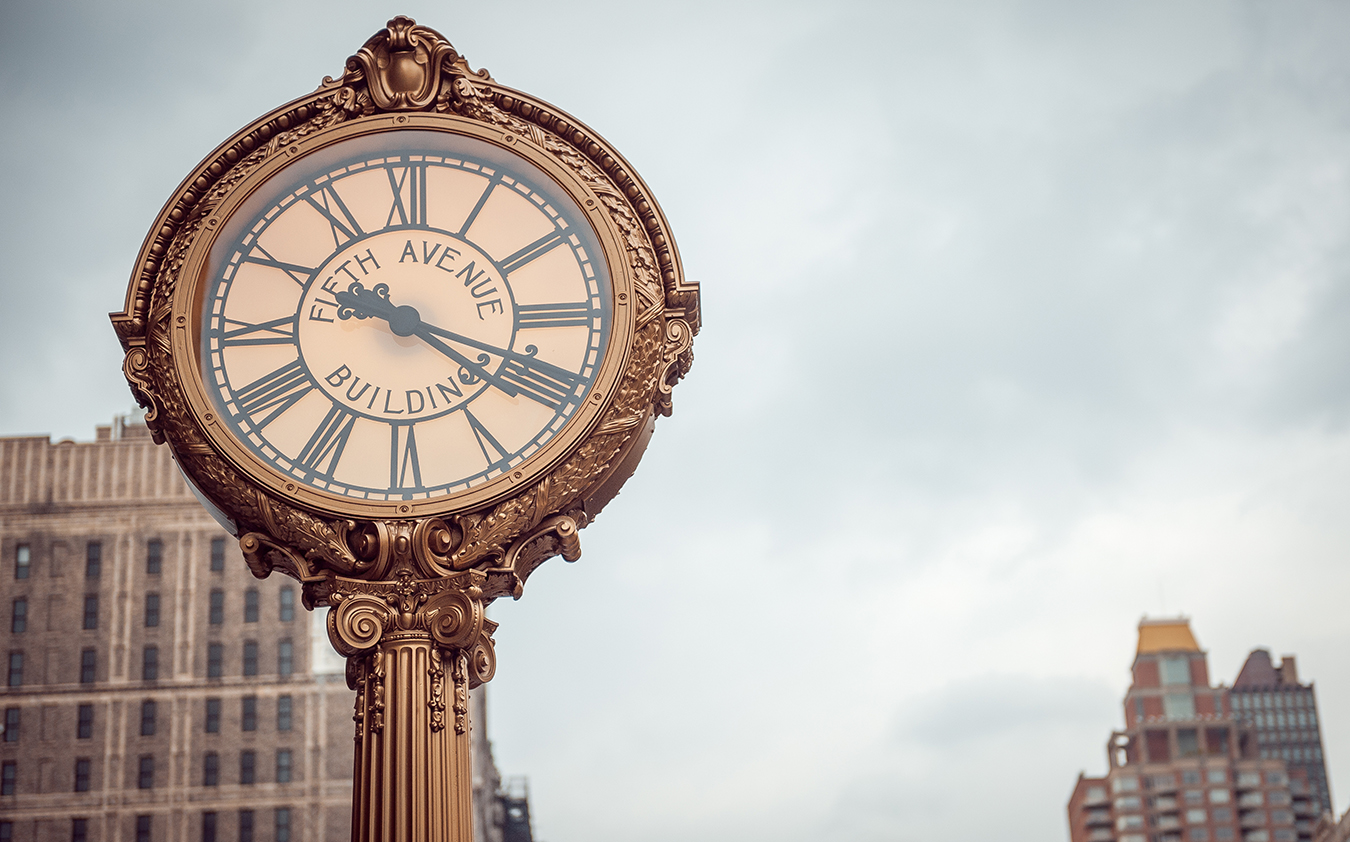
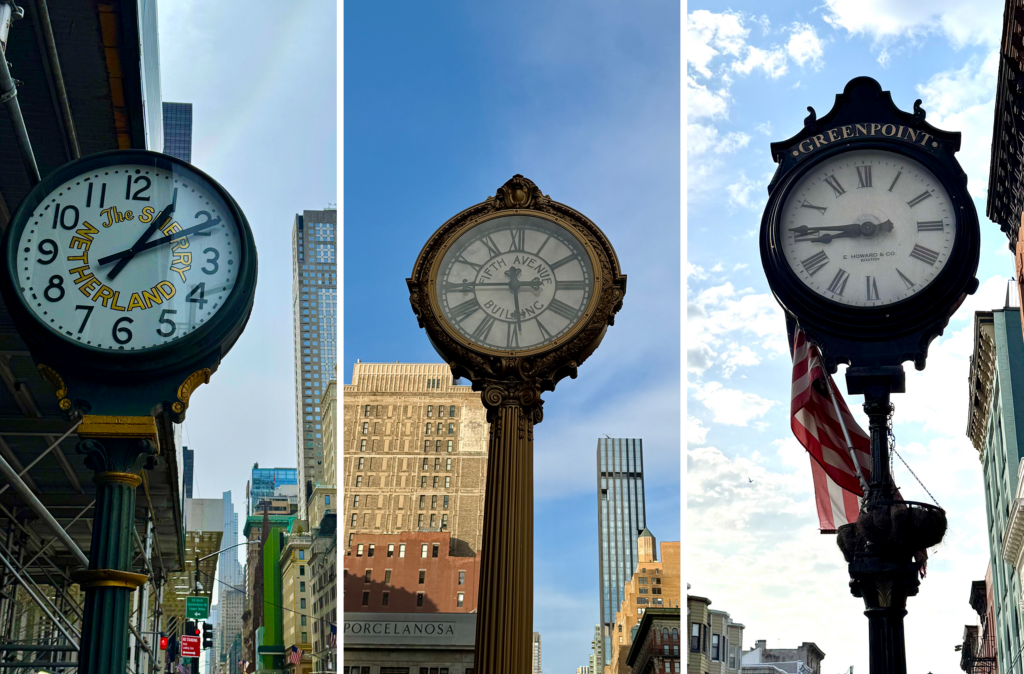
Ah, time. Humanity’s biggest hater. Aside from “How much wood could a woodchuck chuck if a woodchuck could chuck wood,” no question has consistently pestered us more than “What time is it?” In this oft-fast-paced city, knowing where you fall on the spectrum between punctual and tardy can be everything. Before smartphones and omnipresent digital displays, cast-iron sidewalk clocks were a vanguard for keeping us apprised of this info. Now, only seven remain from the time-telling medium’s heyday, scattered across Brooklyn, Manhattan, and Queens.
These ticking innovations in street furniture were introduced through catalogs starting in the 1860s, bringing time-telling convenience to the street level. Local businesses would often buy one, put it right outside, and emblazon their name on it, 15 or so feet high, for all to see. It didn’t take a lot to effectively advertise back then. Actually, the tall timepiece directly across from Central Park’s Grand Army Plaza still publicizes the likewise historic Sherry-Netherland, the building it has stood in front of for nearly a century.
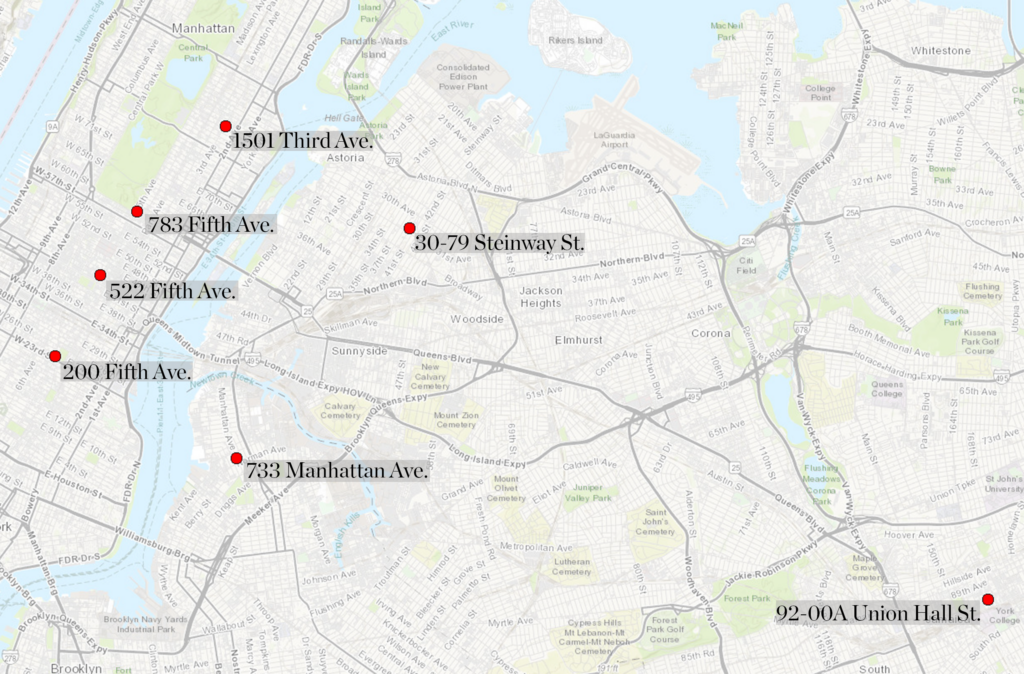
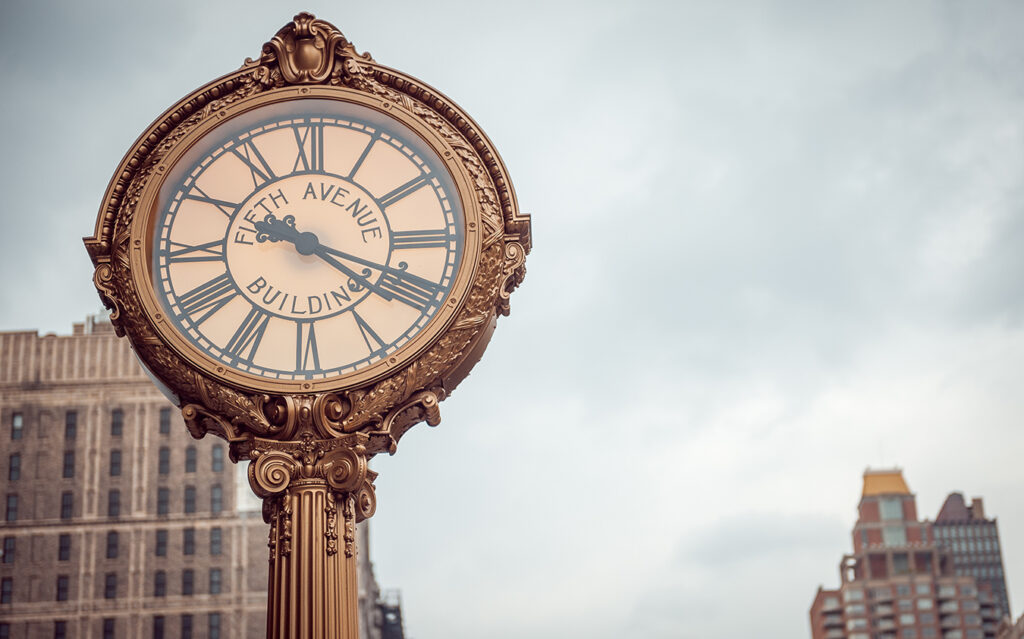
Although the original point of purchase for a sidewalk clock was often a catalog, each of the surviving septet exhibits artisanal personality. The so-called Tiffany Street Clock in the Flatiron District features Roman numerals on its twin dials, leafy gold filigree, and a fluted Ionic column. Elsewhere, crowning ornaments add a touch of grandeur, like the ornate pineapple motif atop the Midtown East clock or the golden acronemion gleaming upon the one in Jamaica. Landmarked timepieces on the Upper East Side and in Astoria are styled as giant pocket watches, complete with oversized screws and fob rings. Preservation efforts have been vital to the clocks’ continued operation. Just to stop trucks from running into it, the Greenpoint clock on bustling Manhattan Avenue had to be relocated, twice reoriented, and made taller — to say nothing of necessary cosmetic and mechanical upgrades.
Regardless of individual looks, all seven clocks contribute much-needed whimsy and character to the streetscape. Plus, if your phone’s battery dies and you’ve lost all sense of temporality in this vast universe, you know where to look.
Pepsi-Cola Sign
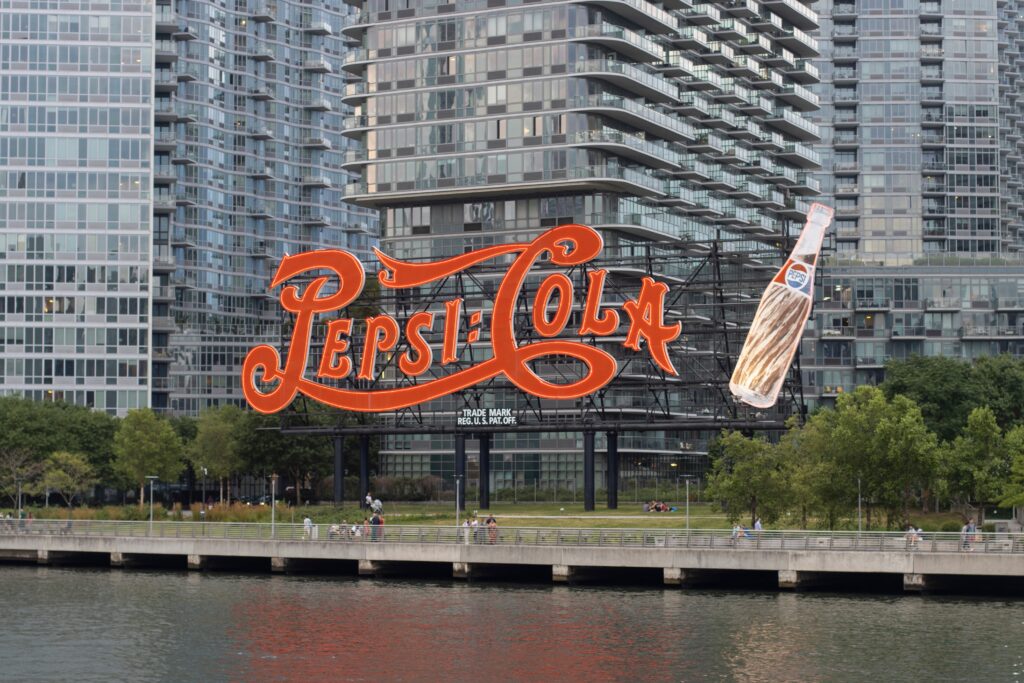
Pepsi okay? Along the Long Island City waterfront, the answer is always yes. Sweeping cursive red lettering, a larger-than-life 50-foot soda bottle, and eye-catching neon borders make the Pepsi-Cola sign in Gantry Plaza State Park impossible to miss, day or night. More than just product placement for one of America’s top five soft drink brands, it highlights a faded tradition of outdoor advertising when all you needed was a few gas-filled tubes to get people’s attention.
The Pepsi-Cola sign we know today is actually a 1993 recreation. Originally erected in 1940, it crowned the company’s headquarters in LIC, beckoning folks with promises of 12-ounce bottles for five cents. Neon’s commercial use was relatively novel at the time, but had become widespread nonetheless in the heyday of Technicolor. Pepsi’s glowing beacon remained for five decades, until a 1992 nor’easter wore and tore it up. Yet its rebuild was so thorough that every detail — even the 1970s-style bottle added during that era to match contemporary design — was preserved. A neon border around said bottle was the only change.
Although the sign is not wholly original and more akin to, say, the choice of a new generation, the mere fact that failed discussions during the 1980s about whether to landmark it occurred at all actually paved the way for a formal designation in 2016. Take note: Sometimes, nebulous bureaucracy works. Today, the sign sits mere feet, plus a few stories downward, from where it once rose along the East River, enchanting as ever despite the fact you’ll now need a whole lot more than one nickel to buy a Pepsi.